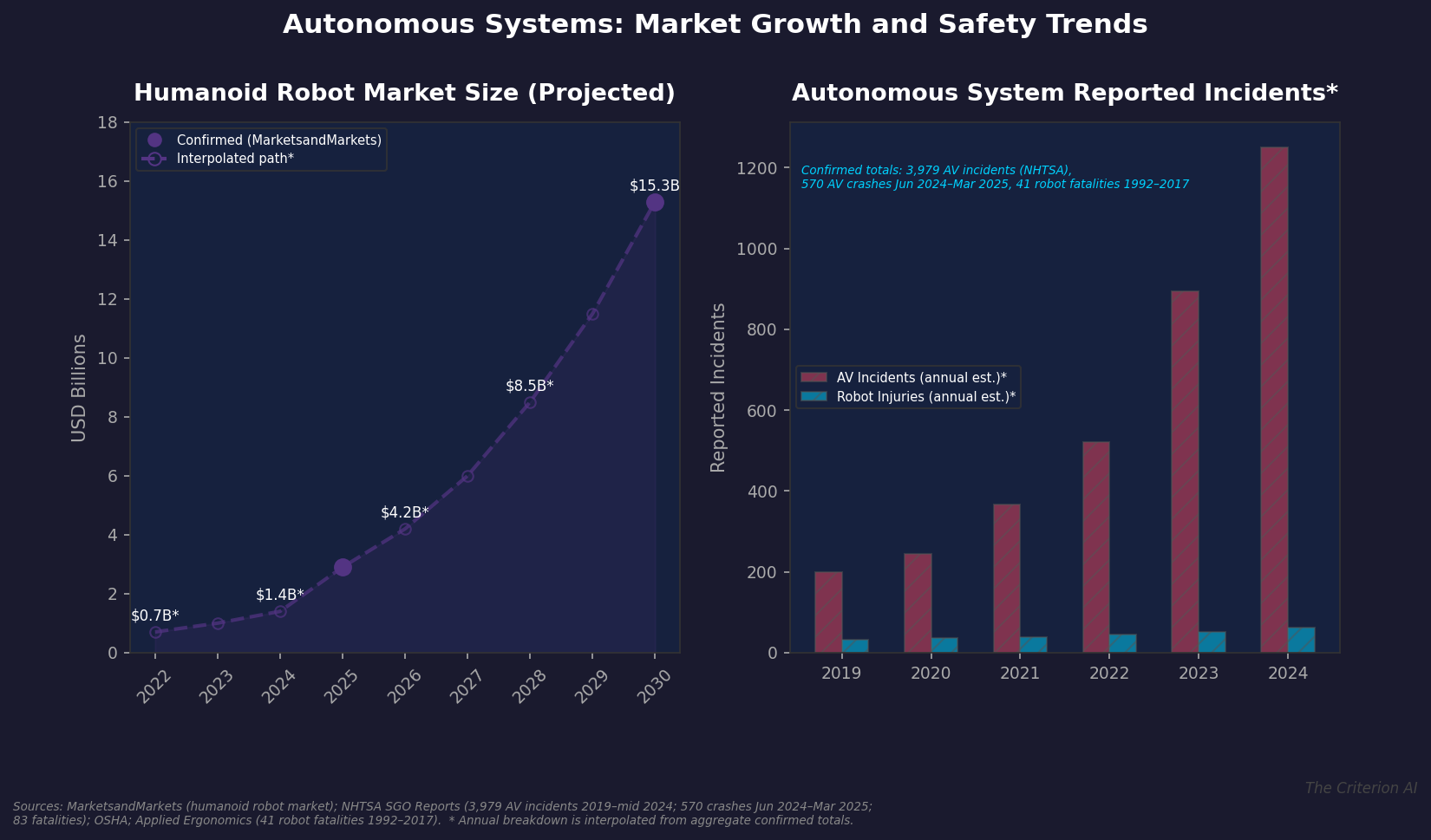
Tesla's Optimus Gen 3 is entering mass production. Elon Musk has announced plans to sell humanoid robots to external customers by the end of 2027, with a "Home Edition" potentially available through lease-to-own programs by late 2026 or early 2027. Industry analysts at MarketsandMarkets project the global humanoid robot market will grow from $2.9 billion in 2025 to $15.3 billion by 2030, a compound annual growth rate of 39.2%.
These are not science fiction numbers. They are market projections backed by real capital expenditure, real manufacturing capacity, and real timelines. And they raise a legal question that the product liability system has never had to answer at scale: who is liable when a 130-pound autonomous machine injures someone in their home?
The Product Liability Framework Under Pressure
American product liability law rests on three traditional theories: manufacturing defect, design defect, and failure to warn. Each of these theories encounters novel complications when applied to autonomous humanoid robots.
Manufacturing defects are relatively straightforward for traditional products. A car with a faulty brake line has a manufacturing defect. But a humanoid robot that behaves unexpectedly because of a software glitch, a sensor calibration error, or an edge case in its training data presents a different analytical challenge. Was the defect in the hardware, the software, the training data, or the interaction between them? Identifying the defective component in a complex autonomous system requires technical expertise that goes well beyond traditional manufacturing quality analysis.
Design defects are even more complex. Under the risk-utility test applied in most jurisdictions, a product has a design defect if the risks of the design outweigh its benefits and a reasonable alternative design existed. For an autonomous robot, the "design" includes not just the physical hardware but the entire software stack: the perception system, the decision-making algorithms, the safety constraints, and the learning mechanisms. Evaluating whether a reasonable alternative design existed requires an expert who can assess the state of the art in robotics engineering at the time the product was designed.
Failure to warn claims will center on what risks were disclosed to consumers. If Tesla sells Optimus to households, what warnings does it provide about the robot's limitations? Does it disclose the conditions under which the robot might malfunction? Does it explain what the robot cannot do? Given the complexity of autonomous systems, the adequacy of warnings will be a recurring battleground.
Sources: MarketsandMarkets, BCC Research, Grand View Research, NHTSA, OSHA
The Incident Data So Far
We do not yet have significant incident data for humanoid robots in consumer settings, because they have not yet been deployed at scale. But we have instructive precedents from adjacent categories.
NHTSA data shows that autonomous vehicle incidents have been climbing steadily. Between June 2024 and March 2025, there were 570 reported crashes involving vehicles with automated driving systems in the United States. Self-driving car incidents reported between 2019 and mid-2024 totaled approximately 3,979, including 83 fatalities.
In the industrial robotics context, OSHA data documents a persistent baseline of robot-related injuries. A 2024 study published in Applied Ergonomics analyzing OSHA Severe Injury Reports found 41 robot-related fatalities in the US between 1992 and 2017. South Korean data shows industrial robots accounted for roughly 5% of work-related deaths from 2014 to 2018. Research published in Safety Science estimates 30 to 40 robot accident cases occur annually in industrial settings, with 80% involving similar failure patterns.
When humanoid robots enter homes, the risk profile changes dramatically. Industrial robots operate in controlled environments with trained personnel and safety protocols. Consumer robots will operate in unpredictable environments with untrained users, children, pets, and the full range of household hazards.
Daubert Challenges for Robotics Expert Testimony
As robotics litigation increases, courts will face Daubert challenges that test the boundaries of what qualifies as reliable expert testimony in this domain. Several dimensions deserve attention.
Interdisciplinary expertise. A humanoid robot is a fusion of mechanical engineering, electrical engineering, computer science, and artificial intelligence. Expert witnesses may be challenged on whether their qualifications span enough of these domains to offer reliable opinions about system-level behavior. A mechanical engineer may understand the robot's actuators but not its perception algorithms. A software engineer may understand the decision-making logic but not the physical dynamics of a 130-pound bipedal machine.
Simulation and testing methodology. Experts may rely on simulations or controlled tests to demonstrate how a robot would behave under specific conditions. Opposing counsel will challenge whether these simulations accurately represent real-world conditions. The Daubert factors of testability and error rate are directly relevant here.
State of the art analysis. In design defect cases, the expert must opine on whether a reasonable alternative design existed. This requires a comprehensive understanding of the robotics engineering landscape at the time the product was designed. Given the pace of innovation in this field, the state of the art can shift significantly in the months between product design and product deployment.
Causation complexity. When an autonomous system causes harm, establishing causation can require reconstructing the robot's decision-making process. This may involve analyzing sensor logs, software execution traces, and the training data that shaped the robot's behavior. Expert testimony on causation in these cases will need to be both technically rigorous and accessible to juries.
Insurance Implications
The insurance industry is watching humanoid robotics with a mixture of anticipation and anxiety. Traditional product liability insurance is priced based on historical loss data for comparable products. But there are no comparable products. A 130-pound autonomous bipedal machine operating in a consumer's home is a genuinely novel risk category.
Several insurance challenges are emerging:
- Pricing uncertainty. Without historical claims data, insurers must rely on modeling and analogies to other product categories. Neither approach is reliable for a product class this novel.
- Coverage scope. Standard commercial general liability policies may not clearly cover AI-related failures, software defects, or harms caused by autonomous decision-making. Coverage disputes will be inevitable.
- Subrogation complexity. If a homeowner's insurance policy covers injuries caused by a household robot, the insurer will seek subrogation against the manufacturer. But establishing the manufacturer's liability requires the same complex technical analysis described above.
- Regulatory risk. As jurisdictions impose new requirements on autonomous systems, insurers will need to assess whether their policyholders' compliance efforts are adequate, creating an additional layer of underwriting complexity.
The Regulatory Gap
Unlike the EU, which has begun to address AI and robotics through the AI Act and the proposed AI Liability Directive, the United States lacks a federal framework for autonomous systems liability. The National Highway Traffic Safety Administration regulates autonomous vehicles, and OSHA has jurisdiction over workplace robots. But no federal agency has clear authority over autonomous consumer robots operating in the home.
This regulatory vacuum means that product liability litigation will proceed under state common law, with courts applying traditional doctrines to genuinely unprecedented technology. The results will be inconsistent, jurisdiction-dependent, and heavily influenced by the quality of expert testimony presented in each case.
Preparing for the Litigation Wave
The humanoid robotics litigation wave is not a question of if but when. Companies manufacturing autonomous robots should be investing now in:
- Comprehensive logging. Robots should maintain detailed records of sensor inputs, decision-making processes, and actuator outputs. These logs will be essential discovery material in any product liability case.
- Safety testing documentation. Every test conducted during development, along with its results and any design changes made in response, should be meticulously documented.
- Warning adequacy review. Consumer-facing warnings and documentation should be developed with litigation risk in mind, informed by expert analysis of foreseeable misuse scenarios.
- Insurance program design. Companies should engage insurance brokers and coverage counsel early to design programs that address the novel risk profile of autonomous consumer products.
For plaintiffs' attorneys, the opportunity is equally clear. Humanoid robot injuries will generate complex, high-value litigation requiring expert witnesses who can bridge mechanical engineering, software architecture, AI decision-making, and human factors analysis.
Conclusion
The humanoid robot market is growing at nearly 40% annually. Consumer deployment is months, not years, away. The legal system must prepare for a category of product liability litigation that has no real precedent. Expert witnesses who can navigate the technical complexity of autonomous systems while communicating clearly to judges and juries will be indispensable.
At The Criterion AI, we see this as one of the most consequential frontiers in AI expert testimony. The questions this technology raises, about autonomy, liability, foreseeability, and the standard of care, will define product liability law for a generation.
The Criterion AI provides expert witness services and litigation support for matters involving artificial intelligence, machine learning, and algorithmic decision-making. For a confidential consultation on an active or anticipated matter, contact us at info@thecriterionai.com or call (617) 798-9715.