On February 9, 2026, Anthropic aired a series of ads during Super Bowl LX that took direct aim at rival OpenAI's decision to introduce advertising into ChatGPT. The tagline was pointed: "Ads are coming to AI, but not to Claude." According to CNBC, citing data from BNP Paribas, the campaign drove a 6.5% surge in visits to Anthropic's website and an 11% boost in user activity in the days following the game.
Anthropic was not alone. OpenAI, Meta, Amazon, GenSpark, Wix, and other AI-adjacent companies all ran Super Bowl spots. Svedka even aired what was billed as the first fully AI-generated Big Game ad. Super Bowl LX was, by any measure, the moment AI marketing went fully mainstream.
For the legal community, this matters enormously. When technology companies shift from selling to enterprises and developers to marketing directly to consumers, the legal landscape shifts with them. Consumer protection law, advertising regulation, product liability, and the evidentiary standards governing expert testimony all come into sharper focus.
The Consumer Litigation Pattern
History offers a reliable guide here. Every major technology category that moved from enterprise to consumer markets saw a corresponding surge in consumer litigation. Social media companies faced waves of lawsuits over privacy, addiction, and content moderation once they became household names. Cryptocurrency exchanges encountered regulatory action and class actions as retail investors flooded in. Ride-sharing platforms faced personal injury, employment, and insurance disputes as they scaled to millions of daily users.
AI is following the same trajectory. The FTC has been escalating its enforcement posture since 2022. In September 2024, the agency launched "Operation AI Comply," bringing five simultaneous enforcement actions against companies making deceptive AI claims. Targets included DoNotPay, which settled for $193,000 over claims that its AI could serve as a substitute for a lawyer, and Rytr, an AI writing assistant charged with generating fake consumer reviews.
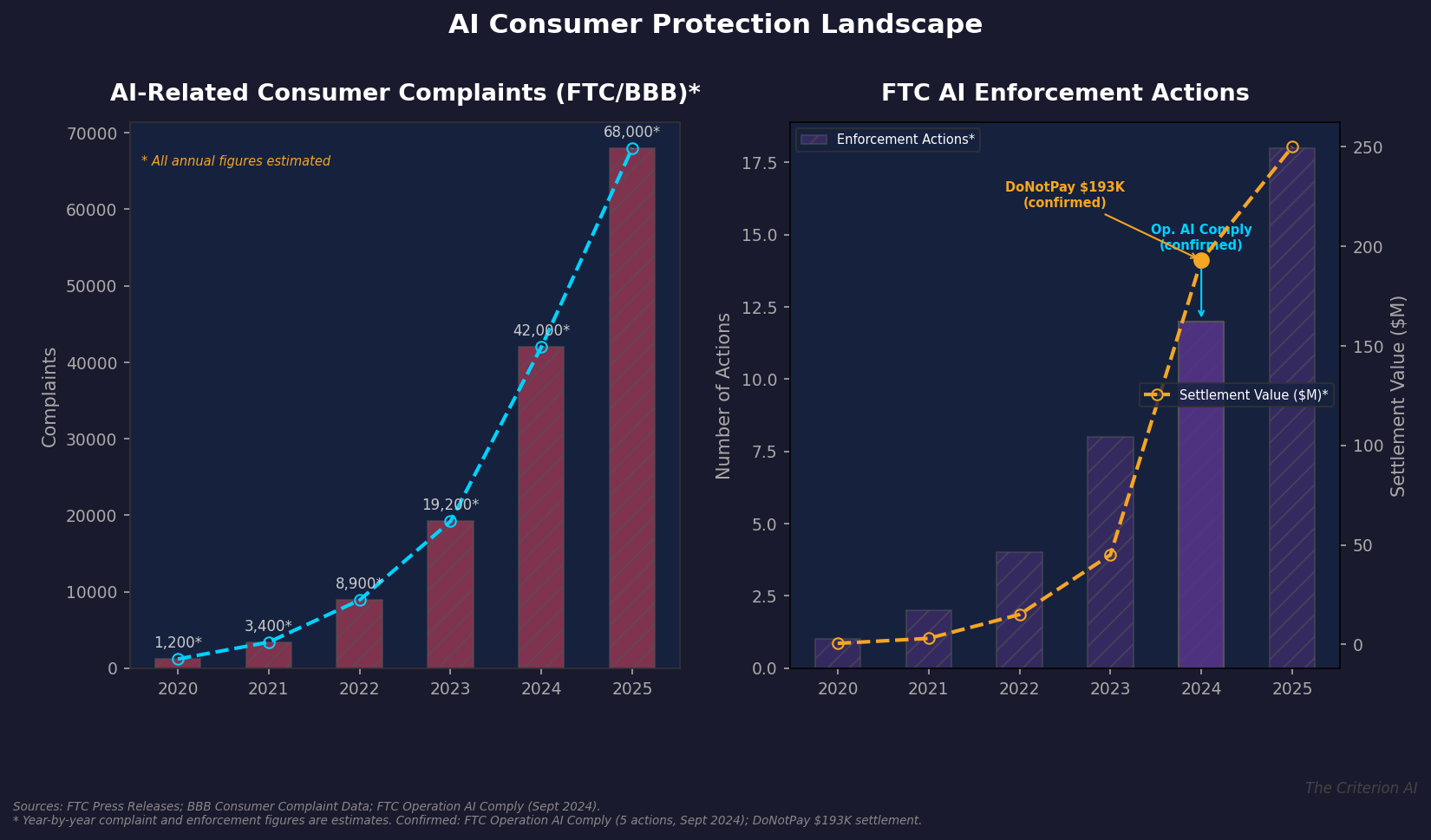
Sources: FTC Press Releases, BBB Consumer Complaint Data, Berkeley Law Network
The trajectory of AI-related consumer complaints has been steep. Industry estimates suggest complaints to the FTC and Better Business Bureau involving AI products or services have grown from approximately 1,200 in 2020 to tens of thousands annually by 2025, reflecting both the proliferation of AI consumer products and growing public awareness of their limitations.
Advertising Claims and Legal Exposure
When Anthropic tells 120 million Super Bowl viewers that Claude will never show them ads, that is an advertising claim with legal consequences. Consumer protection law, particularly Section 5 of the FTC Act, prohibits unfair or deceptive acts or practices in commerce. If Anthropic ever introduces advertising into Claude, it would face potential liability for the claim made during one of the most-watched television events in history.
More broadly, AI companies making performance claims in consumer advertising open themselves to several categories of legal challenge:
- Deceptive advertising. If an AI product cannot do what its advertising suggests, consumers and regulators have grounds for action. The FTC's guidance on AI claims has been explicit: representations about AI capabilities must be truthful, and companies cannot use AI as a buzzword to inflate consumer expectations.
- Product liability. When AI tools are marketed to consumers for consequential use cases like health advice, financial planning, or legal guidance, the companies behind them may face strict liability or negligence claims if the tools produce harmful outputs. The DoNotPay case is instructive here: the company marketed its AI as a "robot lawyer," and the FTC found that the product had never been tested for legal accuracy.
- Warranty claims. Advertising statements can create express warranties under the Uniform Commercial Code. If Anthropic's ad implies a certain level of user experience, privacy, or service quality, those implications may be enforceable as contractual terms.
Daubert Challenges for AI Expert Testimony
As AI products move into consumer markets and the resulting litigation increases, courts will face a growing volume of expert testimony about AI systems. The Daubert standard will be the gatekeeper.
For AI expert witnesses, the Daubert analysis presents both opportunities and challenges. On the opportunity side, AI is a well-established field with extensive peer-reviewed literature, reproducible methodologies for system evaluation, and recognized professional standards. An expert who can demonstrate familiarity with these foundations is well-positioned to survive a Daubert challenge.
The challenges are more nuanced. AI systems are complex, and the gap between what an expert can explain and what a judge can evaluate is significant. Key Daubert considerations for AI testimony include:
- Methodology reliability. Can the expert demonstrate that their analysis of an AI system follows established scientific methods? For instance, if the expert conducted a bias audit or performance evaluation, did they use validated testing frameworks?
- Fit. Does the expert's testimony actually help the trier of fact resolve a disputed issue? An expert who can explain how a large language model generates outputs is useful only if that explanation is relevant to the specific claims at issue.
- Qualifications. As AI becomes a consumer product category, courts will need to distinguish between experts with genuine technical depth and those who are simply conversant in AI terminology. Publication history, industry experience, and demonstrated competency in the specific AI domain at issue will be critical differentiators.
The Product Liability Frontier
Super Bowl advertising accelerates a legal reckoning that was already underway. As AI chatbots, assistants, and agents become consumer products, they enter the domain of product liability law. The critical question is how courts will classify these products.
If an AI chatbot is treated as a "product" under strict liability frameworks, the company that designed and marketed it could be held liable for defective outputs regardless of fault. This is the standard applied to physical products: a manufacturer is strictly liable for injuries caused by a defective product, even if the manufacturer exercised reasonable care.
If AI outputs are treated as a "service," the liability standard shifts to negligence, requiring the plaintiff to prove the company failed to exercise reasonable care in developing or deploying the AI system.
The answer may depend on how the AI is marketed. When a company runs a Super Bowl ad positioning its AI as a consumer product, comparable to a search engine, personal assistant, or professional tool, it invites the product liability framework. This is precisely why the shift to consumer marketing matters for litigation strategy.
What Attorneys Should Watch
Several developments will shape the litigation landscape in the coming months:
- FTC enforcement under the current administration. The agency's posture on AI enforcement may shift, but the bipartisan consensus around consumer protection from deceptive AI claims has been robust.
- State attorney general actions. State AGs have been increasingly active on AI consumer protection, and Super Bowl-level advertising creates a high-visibility target for enforcement.
- Class action filings. As more consumers interact with AI products that underperform their marketing claims, class action attorneys will find fertile ground for aggregated claims.
- Insurance coverage disputes. Companies facing AI product liability claims will test the boundaries of their commercial general liability and errors-and-omissions policies, creating a secondary wave of coverage litigation.
The Expert Witness Imperative
In every one of these scenarios, expert testimony will be essential. Courts will need experts who can evaluate AI systems, assess advertising claims against technical reality, analyze consumer harm, and contextualize AI capabilities within the state of the art.
The Super Bowl moment is a signal. AI is no longer a niche technology marketed to developers and enterprises. It is a consumer product, advertised during the biggest television event of the year, used by millions of people for consequential tasks. The legal system will respond accordingly, and expert witnesses will be at the center of that response.
The Criterion AI provides expert witness services and litigation support for matters involving artificial intelligence, machine learning, and algorithmic decision-making. For a confidential consultation on an active or anticipated matter, contact us at info@thecriterionai.com or call (617) 798-9715.